About Cloud Sandbox
About
A technical field journal by yours truly.
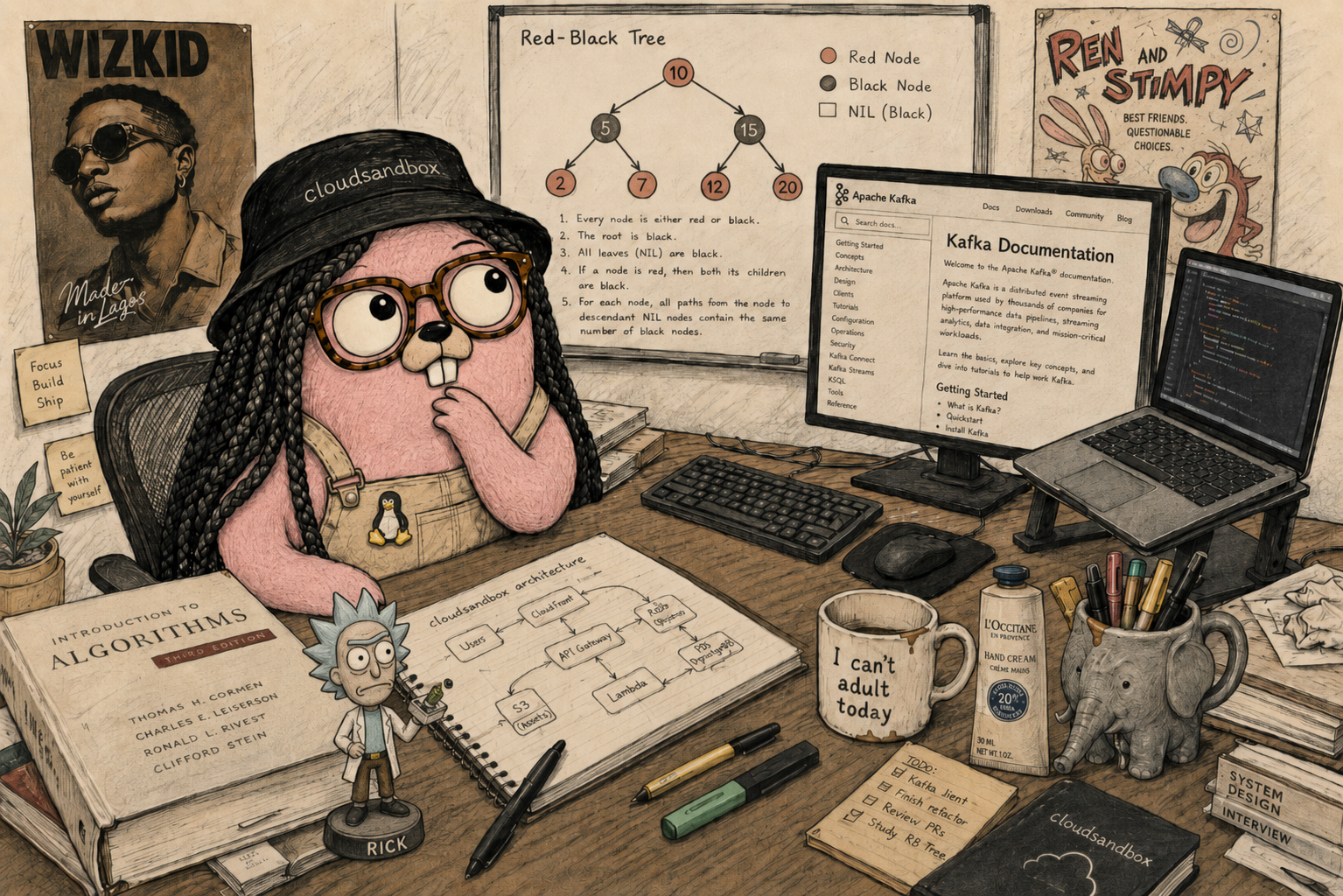
About Miriam Antrobus
Hi there 👋🏾
I’m Miriam Antrobus, a cloud-native consultant working across platform engineering, DevSecOps, Kubernetes and production systems.
A small naming footnote before we go any further: legally, I’m Mariam. I’ve always been known as Miriam. My parents apparently had different ideas about the spelling, so I’ve spent my life answering to both. 🙂
Cloud Sandbox is my technical field journal: a place where I explore how software gets designed, built, secured, deployed, observed and operated in the real world.
I’m a long-time advocate of FOSS and Linux, a proud Go gopher, and generally happiest somewhere in the neighbourhood of containers, Kubernetes, infrastructure, observability and distributed systems.
I keep my lights on and my broadband connected by consulting on cloud-native systems, particularly platform engineering, DevSecOps, Kubernetes, infrastructure and production reliability.
This site is where I get to take those ideas apart, experiment with them and document what I learn.
Why Cloud Sandbox exists
When I became serious about computer science and software engineering, I found no shortage of source code.
GitHub is brilliant for seeing what somebody built, but source code rarely tells the whole engineering story.
Why was the system designed that way?
What trade-offs were made?
How do the pieces fit together?
How does it get from a developer’s laptop into production?
What happens when something breaks?
How do you secure it, observe it, operate it and change it without making everybody nervous?
Those were the examples I wanted to find.
Cloud Sandbox grew out of my desire to build the kind of end-to-end engineering resource I would have found useful myself: not just snippets, tutorials or isolated technologies, but systems with enough context to explain the decisions behind them.
Meet bfstore
Much of Cloud Sandbox is grounded in bfstore, a production-shaped engineering case study I’m building from first principles.
It gives me one coherent system through which to explore the full engineering journey: business requirements, service boundaries, APIs, application architecture, developer platforms, cloud infrastructure, Kubernetes, security, observability and day-to-day operations.
The point isn’t to build the cleverest possible system.
Quite the opposite.
I’m interested in understanding what good engineering looks like when software has to survive contact with production: where simplicity matters, where complexity is justified, what should be automated, what should remain boring and which decisions make life easier for the people who eventually have to operate the thing.
Some parts of bfstore are implemented, some are works in progress and some are plans for later. I try to make that distinction clear rather than pretending the whole thing sprang into existence fully formed.
That evolving process is part of the project.
How I think about engineering
I enjoy new tools as much as the next engineer. Probably more than is healthy.
But I don’t think production systems should become technology exhibitions.
A good platform should help developers ship safely. Infrastructure should be understandable. Security should be designed in rather than bolted on. Observability should answer useful questions. Automation should remove toil without hiding everything behind magic.
And sometimes the mature engineering decision is simply to choose the boring thing that works.
Keep it boring where production matters.
That idea runs through much of what I write here.
A little more about me
Outside the strictly technical side of things, I remain an enthusiastic Linux user, FOSS supporter and Go fan.
There will probably always be a gopher somewhere around here.
There will also, increasingly, be grey hairs in the afro. I consider both signs of progress.
Cloud Sandbox is a tiny slice of the information highway where I get to document what I’m learning, explain the things I wish someone had explained to me and occasionally disappear down a technical rabbit hole so you don’t have to.
Say hello
I’m always happy to hear from people about consulting work, technical collaboration, open-source documentation or something I’ve written or built here.
You can find me on LinkedIn or send me a message through the contact page.
Thanks for stopping by.
Miriam